Spec. Dt. Gökcan ErtaşOrthodontist
 Dt. Sena KırcaDentist
 Dt. Sevinç Cansu KayıranDentist
 Assoc. Prof. Dr. Sezin ÖzerPediatric Dentist
 Spec. Dt. Sude Yıldırım BolatSpecialist in Periodontology
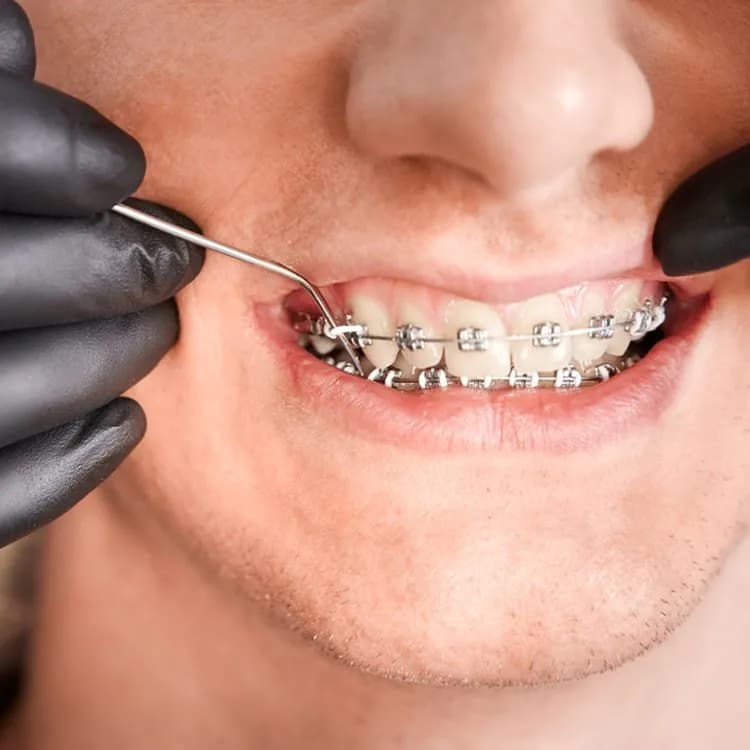
Orthodontic braces treatment is generally completed in 18 to 24 months, depending on the patient's current condition and treatment plan. However, this duration can be as short as 6 months in cases where only mild crowding is corrected, while it can reach 30 months in cases that require more comprehensive treatment. Every patient's smile design journey is unique. In this personalized process, different appliances, such as invisible braces chosen according to aesthetic expectations, or additional procedures performed, directly affect the time needed to reach the targeted healthy and aesthetic result. For this reason, an examination by a specialist dentist is essential for a clear timeframe.
How Long Does Braces Treatment Take in General?
Although there is no definite answer to how long orthodontic treatment will take, it is possible to talk about a general range. For most patients, an average braces treatment covers a period of roughly 18 to 24 months. This is about 1.5 to 2 years. Of course, this is only an average.
If the problems to be corrected are simpler, for example if there are only small gaps between the teeth or very mild crowding, treatment can be completed in a much shorter time, such as 6-12 months. However, when more complex situations come into play, such as severe bite problems, skeletal problems related to jaw position, or bringing impacted teeth into place, treatment can reach 30 months, and in some special cases even 36 months (3 years) or more. Therefore, making comparisons such as "my neighbor's braces came off in one year, so why did mine take two?" is not right, because every mouth requires its own treatment plan and timing.
What Factors Determine the Duration of Braces Treatment?
There are many variables that affect the duration of braces treatment and that differ from patient to patient. When the treatment plan is made, all of these elements are evaluated as a whole. The main factors that directly affect the process are as follows:
The severity and type of the existing tooth and jaw problem
The decision on whether or not to extract teeth for treatment
The patient's age and the condition of the bone structure
Patient compliance and cooperation during treatment
The type of appliance used (brackets or clear aligners)
The experience and treatment approach of the dentist carrying out the treatment
How Does the Decision to Extract Teeth Affect the Duration of Braces Treatment?
Sometimes there is not enough room in the jaw for the teeth to line up properly. In such cases, tooth extraction may be decided on in order to create space. Braces treatments that involve extractions generally take somewhat longer than those without extractions.
The main reason is quite simple. With an extraction, a gap forms in the mouth, and the other teeth need to be moved in a controlled way to close this gap. This movement requires extra time and careful mechanics. In addition, cases that require extractions are generally more complex cases, that is, ones with more severe crowding or bite problems at the start. So when both the difficulty of the underlying problem and the time needed to close the extraction spaces are combined, the total treatment time naturally gets longer.
Does the Patient's Age Change the Duration of Braces Treatment?
The effect of a patient's age on treatment duration is a frequently asked question. The general view is that treatment moves faster in children and teenagers, but the situation is not always that simple.
Children and Teenagers: In individuals at the age of growth and development, the jawbones have not yet hardened and are more flexible. This allows tooth movement to happen biologically faster and makes treatments aimed at guiding jaw growth, in particular, more effective. Early-stage (Phase I) treatments started especially between the ages of 7 and 11 can simplify the comprehensive treatment that comes later and positively affect the overall process.
Adults: In adults, the bone structure is denser and more mature. This means tooth movements may be somewhat slower compared to young people. However, this difference is often not as big as is believed. Once the permanent dentition is complete, there may not be very noticeable differences between adults and teenagers in the duration of comprehensive orthodontic treatment. Still, it is true that some specific and challenging procedures, such as bringing impacted teeth into place, take more time in adults.
Which Types of Crowding Affect the Duration of Braces Treatment?
Every malocclusion (crowding and bite problem) requires its own treatment approach, and this directly affects the duration. As the severity of the problem increases, the treatment time also gets longer. Some common situations that affect treatment times are as follows:
Mild crowding or gaps between teeth (diastema)
Crowding involving severe rotation and lack of space
Overjet (the upper front teeth sitting much farther forward than normal)
Deep bite (the upper front teeth excessively covering the lower front teeth)
Open bite (the front or back teeth not touching each other)
Crossbite (one or more upper teeth sitting inside the lower teeth)
Impacted teeth that remain within the jawbone
How Does Patient Compliance Shorten the Braces Treatment Process?
Perhaps the most important factor that affects treatment duration and is entirely under the patient's control is compliance and cooperation with the treatment. The more carefully you follow your dentist's instructions, the faster and smoother the treatment goes. On the other hand, non-compliance can prolong the process unnecessarily. There are some situations that can negatively affect treatment duration:
Constantly missing or canceling appointments
Using the elastics given by your dentist irregularly or not at all
Neglecting oral hygiene (which leads to gum problems)
Eating hard or sticky foods that damage the brackets
Habits that damage the teeth, such as biting on pens
Not using a mouthguard while playing sports
Paying attention to these points helps the treatment progress as planned and also reduces the frequently felt worry of "do braces hurt," because broken brackets or damaged wires can cause discomfort. The month-by-month change you see in your braces during treatment depends largely on your following these rules.
Does the Bracket System Used Change the Duration of Braces Treatment?
There are different systems used in orthodontic treatment today, and each has its own advantages. However, it would not be right to say that any one system is magically faster than the others. The choice is generally made according to the patient's aesthetic expectations, the requirements of the case, and the dentist's experience. Braces prices are another factor that plays a role in this choice. The main treatment systems are as follows:
Traditional Metal Brackets
Ceramic (Porcelain) Brackets
Lingual Brackets (Invisible Braces)
Clear Aligners (Aligner Treatment)
Traditional Metal Brackets: The most commonly used, most durable, and generally most affordable system. They are extremely effective in treating every kind of orthodontic problem.
Ceramic Brackets: Because they are tooth-colored, they are less noticeable than metal brackets. They are a good alternative for patients with aesthetic concerns. Functionally they work on the same principle as metal brackets and do not make a noticeable difference in treatment time.
Lingual Brackets: In this system, the brackets are bonded not to the visible surface of the teeth but to the inner surface on the tongue side. This makes them completely invisible, and they are also known as "invisible braces." They are especially preferred by adult patients who care a great deal about aesthetics. Treatment time depends on the complexity of the case and is similar to traditional methods.
Clear Aligners: A modern treatment method made up of series of custom-made clear aligners that can be put in and taken out. Their greatest advantages are that they are aesthetic and comfortable. However, the success of the treatment depends on wearing the aligners regularly for at least 20-22 hours a day, that is, on high patient compliance. In suitable cases, treatment times can be similar to traditional methods, while the process may be prolonged in cases where patient compliance is low or in very complex cases.
Are There Special Methods That Shorten the Duration of Braces Treatment?
Yes, in recent years some innovative methods called "accelerated orthodontics," which aim to shorten treatment time, have been developed. These methods are based on the principle of speeding up the process by biologically stimulating tooth movement. However, they may not be suitable for every patient and generally require an additional cost. The main acceleration methods are as follows:
Corticotomy (accelerating bone metabolism through a surgical procedure)
Micro-osteoperforations (triggering tooth movement by creating small holes in the bone)
Photobiomodulation (applying low-level laser therapy)
Vibrating Devices (increasing blood flow by applying light vibrations to the teeth)
You should discuss in detail with your dentist whether these methods are suitable for you, and their potential benefits and risks.
How Long Does the Retention Phase Last After Braces Treatment Ends?
When all stages of braces treatment are completed and the brackets are removed, the treatment is not actually considered finished. The "retention" period, perhaps one of the most important stages, begins. Teeth tend to move back toward their old positions, especially in the first period after treatment. Retainers are used to make sure this excellent result becomes permanent.
The term "lifelong" is generally used for the retention process. This does not mean you will wear an appliance 24/7 for your whole life. Generally, during the first 1-2 years, retainers (fixed or removable) are requested to be used more intensively, mostly at night. During this critical period, the bone and tissues surrounding the teeth settle into their new positions. After that, continuing to use them at the intervals recommended by your dentist (for example, a few nights a week) ensures that the beautiful smile you have achieved stays unchanged for years.