

 Spec. Dt. Gökcan ErtaşOrthodontist
 Dt. Sena KırcaDentist
 Dt. Sevinç Cansu KayıranDentist
 Assoc. Prof. Dr. Sezin ÖzerPediatric Dentist
 Spec. Dt. Sude Yıldırım BolatSpecialist in Periodontology
The differences between an implant and a denture are that an implant acts as a fixed tooth root with titanium screws placed in the jawbone, while a denture is an artificial superstructure that restores the function and appearance of missing teeth. An implant is a surgical procedure; a denture is planned as fixed or removable and can be implant-supported. Dental implant treatments aim to provide long-term stability by placing biocompatible materials into the bone tissue. Through a process called osseointegration, the implant fuses with the bone, and a crown, bridge, or full denture can be placed on top of it. This method offers treatment for missing teeth without damaging the neighboring teeth. Fixed and removable denture types are planned according to the patient's oral condition and bone support. While bridges take support from the neighboring teeth, full dentures are used in toothless jaws. Dentures improve the cosmetic appearance and support chewing and speech functions. The healing process after intrabony implant surgery and the planning of the denture depend on the patient's systemic health and oral hygiene. With proper care, implants are long-lasting. Regular checkups and maintenance of dentures play a critical role in preserving tissue health.
Implants and Dentures: Definitions and Basic Function
A dental implant is a titanium screw that imitates the root of a lost tooth. This screw is placed in the jawbone through a surgical procedure and fuses with the bone to form a solid foundation. The artificial tooth (crown) placed on top restores the look and function of a natural tooth. Implants can be used to support a single tooth or multiple teeth. Dentures, on the other hand, are artificial teeth that replace lost teeth, usually made of materials such as acrylic or porcelain. They are held in the mouth by relying on neighboring teeth or the gums.
Structure and Advantages of a Dental Implant
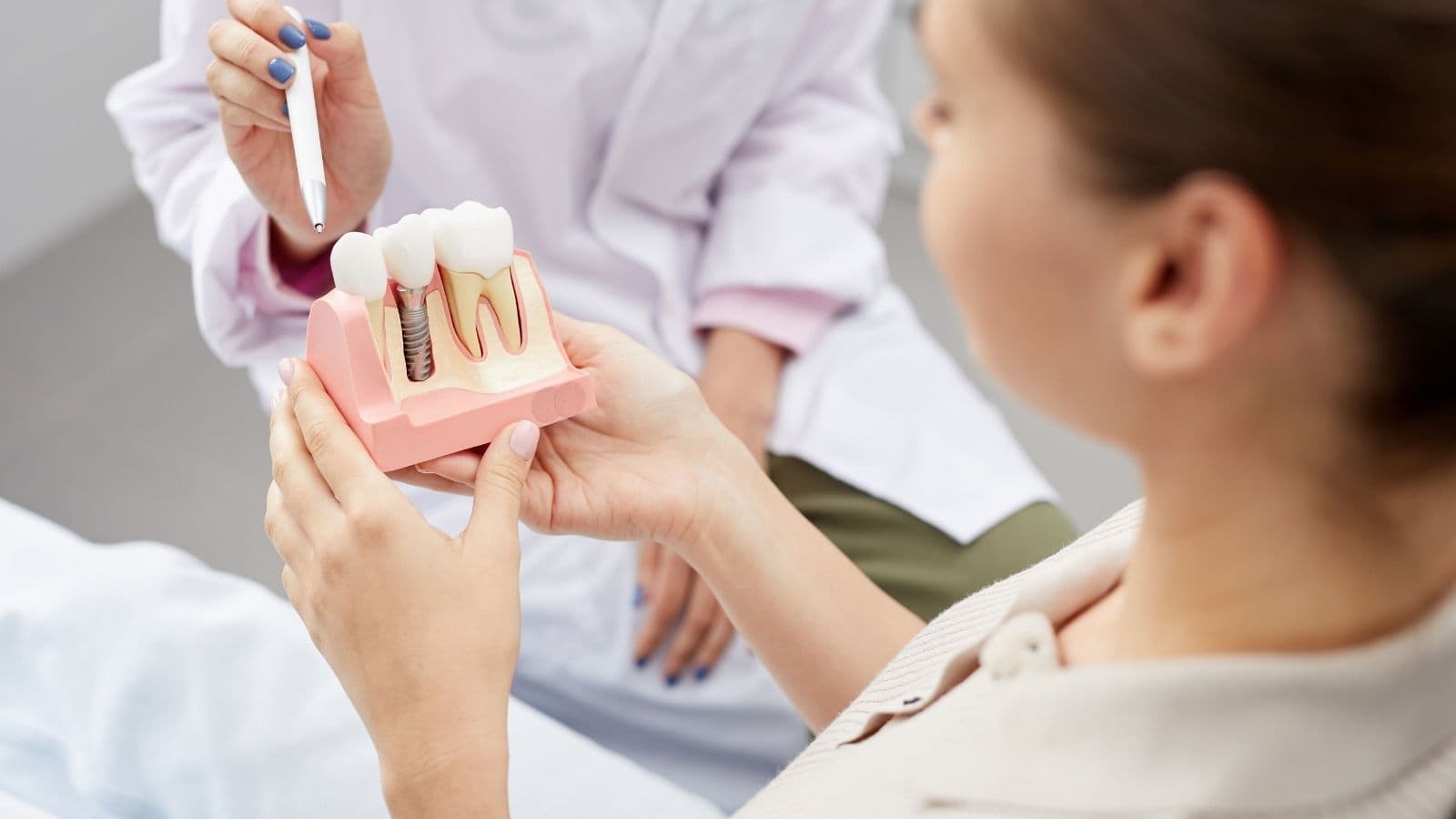
The main components of a dental implant are: the implant screw (a root-like piece made of titanium), the abutment (the connecting piece between the implant screw and the crown), and the crown (the visible artificial tooth). Because implants connect directly to the jawbone, they offer the feel and function closest to natural teeth. They help preserve facial contours by preventing bone loss. They also do not damage neighboring teeth, which makes them a healthier option in the long term. With proper care, implants can last a lifetime.
Types and Disadvantages of Dentures
Dentures are generally divided into two main categories: removable dentures (complete or partial) and fixed dentures (bridges). Removable dentures can be taken out and put back in by the patient. Partial dentures are designed according to the number of missing teeth and are attached to the remaining natural teeth or with special clasps. Complete dentures are used when all teeth are missing and hold onto the oral tissues through a suction effect or with adhesives. Fixed dentures (bridges) are created by trimming down the healthy teeth on either side of the missing tooth and placing porcelain crowns over them. Disadvantages of dentures include loosening over time due to bone loss, a feeling of discomfort during speaking and chewing, the sensation of a foreign object in the mouth, and care that can be more laborious.
Key Differences Between Implants and Dentures
The most obvious difference between implants and dentures is their support systems. Implants integrate directly into the jawbone, while dentures rest on neighboring teeth or the gums. This fundamental distinction brings many other differences with it. Here is a detailed comparison of these differences:
Support Mechanism: Attachment to Bone vs. External Support
Implants bond to the jawbone through a process called osseointegration. This means the implant becomes fully integrated with the bone. As a result, chewing forces applied to the implant are transferred directly to the bone. Dentures, on the other hand, are usually supported by clasps that rest on neighboring natural teeth or by a base that sits on the gums. Over time, this external support can cause wear on the neighboring teeth or bone loss in the jaw.
Permanence and Durability: A Lifelong Solution or a Temporary One?
With proper care and hygiene, dental implants can last a lifetime. Because they are firmly anchored in the bone, the risk of breaking or coming loose is very low. Dentures, however, need to be replaced or repaired at certain intervals because of wear of the material, breakage, or changes in the gums. While the average lifespan of removable dentures is 5-10 years, the lifespan of bridges is more variable and depends on the health of the neighboring teeth.
Comfort and Function: Natural Tooth Feel or an Adaptation Period?
Implants offer the feel and function closest to natural teeth. They restore chewing strength almost fully and do not create the feeling of a foreign object in the mouth. There is no movement or slipping while eating or speaking. Dentures, especially at the beginning, can cause adaptation problems such as a feeling of fullness in the mouth, difficulty speaking, and slipping while chewing. These problems may decrease over time, but it is usually difficult to reach the level of comfort that implants provide.
Cosmetic Appearance: Naturalness and Harmony
Both methods can give cosmetically satisfying results. However, because implants are placed individually, they complete the alignment of the teeth and the smile aesthetics in a more natural way. Dentures, especially removable ones, can sometimes look more artificial or show a mismatch over time as the gums recede. Crowns placed on implants are designed to match the neighboring teeth exactly in color and shape.
Jawbone Health: Preservation or Potential Loss?
Implants stimulate the jawbone and prevent bone loss (atrophy). Thanks to the pressure the implant screw applies to the bone, the bone tissue stays alive. Dentures, especially complete dentures on the lower jaw, cannot distribute the chewing forces on them evenly to the bone and can cause bone loss. Over time, this impairs the fit of the denture and requires more frequent adjustment or replacement.
Surgical Intervention and Healing Process: Intensity and Timing
Dental implants require a surgical intervention. This procedure is usually performed under local anesthesia, and the healing process can take several months. The fusion of the implant with the bone (osseointegration) is an important part of this period. Dentures, on the other hand, usually do not require surgery (tooth preparation is done for bridges) and can be completed in a shorter time. However, the long-term benefits of an implant may justify the initial surgical process.
Cost: Initial Investment vs. Long-Term Expenses
In general, dental implants are higher than dentures in terms of initial investment cost. However, the long lifespan of implants and the fact that they potentially require less maintenance and repair may make them a cost-effective solution in the long run. Although dentures have a more affordable initial cost, repairs, adjustments, and eventual replacement costs over time can increase the total expense.
Who Is It NOT Suitable For? (Contraindications)
Who Is Not Recommended for Dental Implants?
Patients with diabetes that cannot be brought under control: Blood sugar imbalance can negatively affect the healing process.
Those with severe bone loss who are not suitable for bone grafting: An implant cannot be placed without sufficient bone support.
Some patients with immune system deficiencies: Because of the risk of infection and difficulties in the healing process.
Those who do not take care of their oral hygiene: The risk of infection around the implant increases.
Pregnant women: Surgical procedures are generally not recommended.
Young individuals whose jawbone development is not complete: The position of the implants may change over time.
Those receiving intensive radiotherapy or chemotherapy: The healing process can be seriously affected.
Who Are Dentures NOT Ideal For?
Those who feel extreme discomfort while wearing dentures: People who have serious difficulty with basic functions such as speaking and eating.
Those who constantly complain about dentures slipping or loosening: This can reduce quality of life, especially with removable dentures.
Those seeking the feel and function of natural teeth: Dentures cannot fully replace natural teeth.
Those who cannot tolerate the sensation of a foreign object in the mouth: For some people, dentures can cause a constant feeling of fullness.
Those who do not want to take responsibility for denture care: Regular cleaning and maintenance of dentures should not be neglected.
Those who do not want jawbone loss to progress: Especially in the lower jaw, dentures can accelerate bone loss.
Implant and Denture Procedures: A Step-by-Step Journey
Dental Implant Procedure
Examination and Planning: The dentist evaluates suitability for an implant through an oral examination, X-rays (panoramic, tomography), and digital measurements. Jawbone density and nerve structure are examined. If necessary, computer-assisted 3D planning is performed.
Surgical Placement: Under local anesthesia, a small incision is made in the area where the implant will be placed. A socket is prepared in the jawbone and the implant screw is carefully placed. The incision is closed and the healing process begins. This stage usually takes 30-60 minutes.
Osseointegration (Fusion with the Bone): It usually takes 2 to 6 months for the implant to fuse completely with the jawbone. During this time, it is important that no load is placed on the implant. In the upper jaw, this period may be slightly longer.
Abutment Placement: After the implant has fused with the bone, the abutment (connecting piece) is screwed onto the implant in a second minor procedure. This piece forms the platform on which the crown will be placed.
Crown (Artificial Tooth) Fabrication and Placement: The dental technician prepares the crown according to the patient's mouth measurements, in a color and shape that matches the neighboring teeth. Finally, the crown is cemented or screwed onto the abutment. Your new tooth is now ready for use.
Denture Procedure
Removable Dentures (Complete or Partial):
Taking Impressions: The dentist takes detailed impressions of the mouth. 2. Creating the Wax Model: In the laboratory, a wax model that fits the patient's mouth is prepared. 3. Try-In: The wax model is tried in the patient's mouth. Color, size, and fit are checked. 4. Final Fabrication: The approved wax model is turned into a denture using acrylic or similar materials. 5. Delivery and Adjustments: The denture is delivered to the patient. Adjustments may be needed in the first few days for adaptation to speaking and chewing.
Fixed Dentures (Bridges):
Tooth Preparation: The neighboring natural teeth that the bridge will support are specially trimmed down so that the crowns can be placed. 2. Taking Impressions: Precise impressions are taken of the prepared teeth and the area of the missing tooth. 3. Temporary Bridge: A temporary bridge is made to be used throughout the laboratory process. 4. Try-In: The permanent bridge produced in the laboratory is tried in the patient's mouth. Color, fit, and margin fit are checked. 5. Cementation (Bonding): The approved bridge is permanently bonded onto the prepared teeth with special adhesives (cement).
Common Mistakes and Things to Avoid
Things to Avoid in Implant Treatment:
Inadequate Planning: Not examining in detail whether there is enough bone for implant placement and the condition of the nerves. This can lead to implant failure or nerve damage.
Lack of Hygiene: Not giving enough importance to oral hygiene before, during, and after surgery. Infections around the implant (peri-implantitis) can cause serious problems.
Early Loading: Applying excessive force on the implant before osseointegration is complete. This can prevent the implant from fusing with the bone.
Smoking: Smoking impairs blood circulation, slows the healing process, and increases the implant failure rate.
Rushing the Choice of Dentist: Being treated by a dentist who has no experience in implant surgery or has not received sufficient training.
Skipping Follow-Up Appointments: Regular checkups are essential for monitoring the healing process and detecting possible problems early.
Things to Avoid in Denture Treatment:
Neglecting Denture Care: Not cleaning dentures regularly leads to a buildup of bacterial plaque and bad breath.
Using Dentures with Excessive Force: Making excessive jaw movements, especially with complete dentures, to keep them from slipping while eating hard and sticky foods. This can damage the gums.
Habits That Put Load on the Denture: Habits such as teeth clenching (bruxism) or nail biting can damage dentures.
Ignoring Changes in the Mouth: Disregarding signs such as sores on the gums, misfit at the edges of the denture, or loosening.
Trying to Repair Dentures Yourself: Trying to repair broken or bent dentures yourself or through unauthorized people can cause the denture to be damaged further or its full fit in the mouth to be impaired.
Forgetting to Care for Neighboring Teeth: Patients who use a fixed denture (bridge) not regularly cleaning under the bridge and the supporting teeth.